

Mathematical Modelling
Mathematical models are key to understand the complex nonlinear behaviour of infectious diseases, and date back at least 250 years when Bernoulli tried to influence public health authorities by presenting smallpox modelling results:
“I simply wish that, in a matter which so closely concerns the wellbeing of the human race, no decision shall be made without all the knowledge which a little analysis and calculation can provide” – Daniel Bernoulli 1760.
Since then, numerous approaches have been implemented to understand the dynamics of endemic and emerging infectious diseases. Mathematical models were used to identify the optimal distribution of resources towards reaching elimination both on the local and the global scale. For the HIV epidemic, models were used to estimate how public health interventions help towards reaching elimination targets – both in resource rich and resource limited settings.
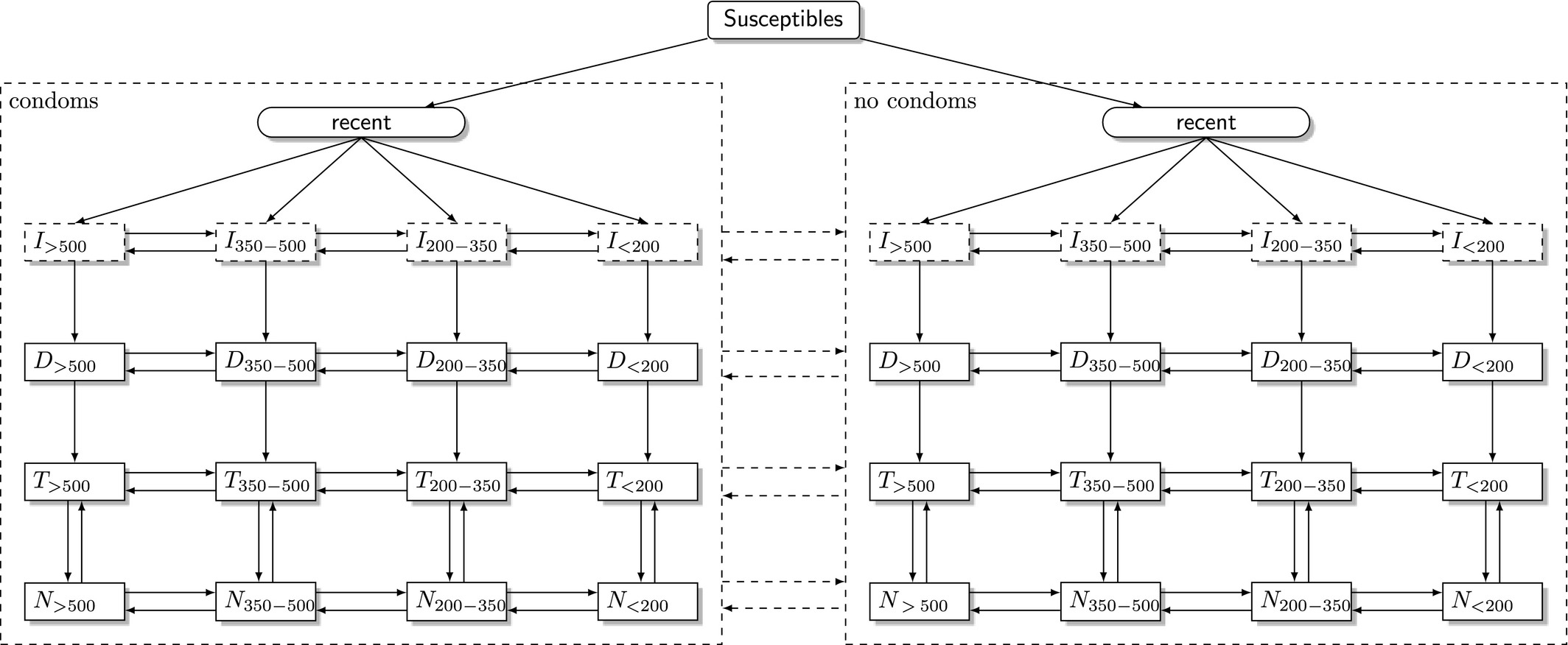
To highlight one example, in the project entitled “Quantifying the impact of different drivers of the HIV epidemic among men who have sex with men in Switzerland” we combined observational data on relevant epidemiological and clinical processes with a mathematical model (see Figure), and could show that the ‘test and treat’ approach is most effective in reducing the number of new HIV cases among men who have sex with men (MSM) in Switzerland. Only a moderate population-level effect was estimated for early initiation of ART and a weak effect for the change in condom use of diagnosed MSM. Protecting HIV-negative individuals who are not using condoms with HIV pre-exposure prophylaxis (PrEP) was shown to have a major impact
Figure: Schematic presentation of the model
Mathematical modelling studies towards understanding key aspects of the ongoing HIV epidemic included:
- Quantifying the drivers of HIV transmission and prevention in men who have sex with men: a population model-based analysis in Switzerland
- Assessing the drivers of syphilis among men who have sex with men in Switzerland reveals a key impact of screening frequency: A modelling study
- Impact of scaling up dolutegravir on antiretroviral resistance in South Africa: A modeling study
